Showing posts with label SUD. Show all posts

Wednesday, May 11, 2011

New Walk Ways for New Bell

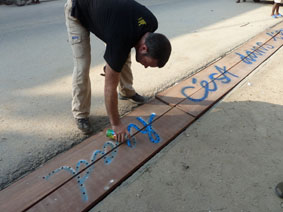
Next week, Xandra Nibbeling and Kamiel Verschuren accompanied by Lucas Grandin, will travel to Douala to continue working on New Walk Ways for New Bell, Verschuren's work in the township of New Bell, where they will be working with Patrick and his team on these new walkways on the open sewer system. Grandin will also be doing some maintanance on the Jardin Sonore in Bonamouti.

This open system is not only found in this quarter, but throughout the city of Douala. Now that the rain season is approaching, the clugged sewer system will be causing more and more problems, causing polution of the clean drinking water. Read an earlier post on this huge problem here.

The project will not only be of help to the people directly involved (i.e. the inhabitants of the streets where we will work), but is above all intended to create an awareness of one's own responsibility in how to deal with the circumstances in which we live in a way that goes beyond the individual. 
More information on New Walk Ways for New Bell.


Besides working on this project - supported by FondsBKVB -  the Ars&Urbis symposium organized by Doual'art on 24-26 May, will be attended, aiming to look forward to the next Salon Urbain de Douala, to be held in 2013.

Keep an eye on the next post!

Sunday, January 16, 2011

The City of Douala and Water

By Berend van der Lans, Architecture plus

La Nouvelle Liberté by Joseph-Francis Sumégné, 2007

Doual’art plays an exceptional role in the city of Douala, by initiating and stimulating urban interventions by artists and public artwork at several locations at a variety of scales in the city. The non-governmental organization, headed by Princess Marilyn Douala-Bell, Didier Schaub and Paulin Tchuenbou, has influenced the image of Douala through their projects undertaken in the last two decades.

Since 2007, the activities and events undertaken by the organization are knitted together through triennial events. The second ‘Salon Urbaine de Douala’ (SUD2010), took place between 4 and 11 December 2010 and was related to the theme of Douala’s somehow troubled relationship with water.

The origin of the city of Douala is formed by a group of small settlements on the banks of the Wouri estuary, populated with fishermen. The Douala culture is hence strongly related to water, both in myths and customs.

Since the German settlers colonised Cameroon, the areas on the banks of the river were reserved for Europeans and later were fully used for harbour activities. For the people of Douala, direct access to the Wouri was nearly fully cut off, the city now seems to be positioned with its back turned to the river.


The harbour zone is blocking any contact between the city and the Wouri estuary
(image: Mauro Alessandro Lugaresi)


Douala is known as one of the places in the world with the highest amount of annual rain fall. The unplanned sprawl of the city has been frustrating the natural flow of the abundant seasonal streams of water, creating numerous problems in the densely inhabited city. Yearly floods result in destroyed housing, damaged private and public asset and in serious health threads to Douala’s inhabitants. Nonetheless, the abundant availability of water also creates chances.

In 2011 construction works start of a new deepwater port in Kribi. The idea is to shift part of the harbour activities of Douala to Kribi and Limbe, another town close to the ocean. In this way the continuous deepening of the Wouri to Douala for deepwater vessels can be avoided.

This results in challenges as well as threads for the largest and economically most active city of Cameroon. The banks of the Wouri will become accessible for the people of Douala once again, hopefully in such a way that the relationship between the Wouri and the Douala inhabitants is not only present in myths and the yearly Ngondo ceremony, but on a more firm basis.

On the other hand, the harbour offers a great direct and indirect economic driver for a large majority of the population of the Douala region. The shift of harbour activities will threaten the income positions of many families and stimulate them to follow the harbour bound companies. It remains to be seen, what impact this will have on the city. It seems obvious that any new plan for the gained harbour banks should include new economic developments to avoid an increase of poverty in the region.

While above and more issues were discussed during ‘conferences’ at the Doual’art premises, SUD2010 also offered presentations of many artworks, vernissages and performances at other locations in the city.


 Performance by Regina Geoger along the banks of the Wouri river,
attracting many harbor workers

Some of the work which was presented clearly developed a dialogue with the people of Douala, either at large or within specific areas.

At Bonamouti two projects were developed. Le jardin sonore by Lucas Grandin offers a vertical garden where the people of the neighbourhood can retreat and enjoy the sounds created by water drops dripping off the structure. Salifou Lindou, a painter and sculptor living in Bonamouti, created Face à l’Eau, an installation of five panels, offering privacy at a bathing site on the banks of the Wouri for the men of the area. 

Top: Le jardin sonore by Lucas Grandin at Bonamouti
Bottom: Face à l’Eau by Salifou Lindou
(photos from www.doualart.org)

In New Bell, another neighbourhood of the city, one of the oldest areas and with a high density, several artists created food for thought for the inhabitants. Hervé Yamguen developed Les Mots Écrits, a poetic approach for his home neighbourhood by involving 5 rappers into creating songs, of which certain lines were executed as wall sculptures at several spots of the area. The rap songs were performed during SUD2010 and recorded onto the CD Wash mes ways (to be downloaded via the SUD2010 website). Kamiel Verschuren explored a pragmatic approach with New Walk Ways New Bell, by developing timber covers for the open sewers of New Bell, once covered by concrete slabs but since long open. The execution of these covers, only at specific locations, created discussions amongst the inhabitants, that it would be good to also develop covers for the parts which are still open and continue to collect dirt and rubbish, thus blocking the stream and resulting in flooded streets with contaminated water.
Hervé Yamguen explaining one of the wall sculptures of Les Mots Écrits in New Bell

New Walk Ways New Bell by Kamiel Verschuren

The Dutch artist Ties ten Bosch settled for 2 months in Ndogpassi, a more recently developed neighbourhood. Many people living in this area did migrate from villages upcountry. The settlements have a more informal feel but by lack of authority are toughly managed by a chef and a committee of men. Via this communal organisational system, decisions on maintenance of public services are made, but also financial assistance for inhabitants who are in need for some help. Diving in deep by Ties Ten Bosch is rather a story than an art work in situ; he documented his stay in the area via video, bottles of water and images. Meanwhile he challenged his temporary neighbours in developing projects with sometimes smaller, sometimes as larger impact on the liveability of the area. While in full contact with the chef and the committee, he developed street names and signs for the main arteries of the neighbourhood. Daily water samples were showcased as a diary of the stream through the area. The force majeure was the construction of a bridge between Ndogpassi and the neighbouring area on the other side of the stream. Shortly after SUD2010 Ten Bosch returned home. The impact of his work remains to be seen, but the bridge is sturdy enough to survive many years of neglect.
The water bottle diary as part of Diving in deep by Ties ten Bosch in Ndogpassi

In the same area, at a beautiful location around and above a local source forming the heart of Ndogpassi, Philip Aguirre developed Source. The project, basically an amphitheatre following the existing shapes of the landscape, will be executed in 2011, but was presented to the chef, the committee and the neighbourhood with a celebrative ceremony during SUD2010. This ceremony proved that the location forms an excellent stage for similar events.

The presentation of Source by Philip Aguirre at Ndogpassi

Individually the impact of the above and other projects developed under the umbrella of Doual’art are minimal and it remains to be seen if these projects really do result in creating awareness of the people of Douala. On the other hand, taking into account the involvement of the people and the reaction on the projects, the positive, aesthetic but hands-on approach does work catching. It makes it useful to return to Douala on a regular basis. It is to be hoped that many Salons Urbains de Douala will follow.

SUD2010 is organised by Doual’art and supported by ICU art projects.
More info on www.doualart.org.

Underneath, you will find some more images taken by Berend van der Lans during SUD2010.


All well dressed and well registered during the Ngondo ceremony
Doual’art premises

Arrival of palm trunk for palm wine production, part of the full recycling program by 2012 Architects
Ties ten Bosch explains Diving in Deep in Ndogpassi
Intermezzo during the presentation of Source by Philip Aguire

Pont Source by Ties ten Bosch in Ndogpassi

La Colonne Pascale by Pascale Marthine Tayou (bottom left) at a mayor junction in New Bell
Vernissages with work from Boris Nzebo (top) and Alioum Moussa (bottom)

Friday, December 24, 2010

Image report


The SUD2010 was a very successful second edition of this triennale on urban art in the city of Douala. Many beautiful projects have been presented, or commenced to be continued in the coming years. Thanks to everybody who put their, sometimes endless, energy in this wonderful project; artists, participants, visitors, citizens of Douala, etc, etc.

On the website of the SUD2010, you will find a report in images on all artistic projects of the SUD2010. The SUD logo will guide you through the website. See: www.doualart.org/SalonUrbainDouala2010/

Monday, December 13, 2010

Bili Bidjocka, Jengu Project


All springs run to the river

Bili Bidjocka has been hunting springs all over the city of Douala, wherever water springs and life spreads around it; he creates an itinerary that illustrates the continuous movement and connections that are normally invisible, beneath our steps; he explores a new interface that may enable us to become aware of and take part in the inner life of the city.

Bili Bidjocka is an artist from Cameroon who started and directed the Matrix Art Project Center of Bruxelles and who lives in Paris; his work has been exhibited in many personal and collective exhibitions among which “Africa Remix” as well as the Biennials of Venice, Dakar, Havana, Taipei.
Doual’art has commissioned the work produced by Bili Bidjocka on the theme of water, the heart and center of the reflection of the second edition of SUD – Urban Salon of Douala dedicated to public art which takes place in Cameroon from December 4th to December 11th, 2010.

For doual’art and for SUD Bili Bidjocka has produced a map exhibited on a large wall inside the Art Centre and a series of 180 flags placed both on the only bridge that crosses the river Wouri and near the springs identified during the preliminary research.
The map is a simple portrait of the city seen from above; a drawing on the wall with lines that follow the boundaries of the city. Light blue strings of thread lead the water towards the river and recreate the hair of Jengu. Jengu is the title of the work (Bili Bidjocka & Yves Makongo, Jengu Project Work in Progress: Do It Yourself, SUD 2010); Jengu is also the spirit of the river Wouri, a creature who, in popular tales, will appear either as a siren (like the famous Mami Wata who is part of the tradition of many African countries along the coast of the ocean) or as a small creature with fin instead of hands and feet. If the portrait of Jengu may change in each tale, the common element is represented by its long hair that seduces and captures human beings. This very hair, created with threads of water leading to the river, is the principal element of Bili Bijocka’s map. Douala seen from above through the eye of the artist, is a new portrait of Jengu, an imaginary portrait like all portraits of Jengu’s, an imaginary map like all maps on which symbols, which most viewers can interpret, evoke places.
The map, though, is no common representation of Douala: few of its over 4 million people use maps to surf through the city, few are familiar with air views or the symbols of geography maps.

That is why Bili Bidjocka speaks of real, hidden, imaginary and virtual places. The map, the flags and the research help the viewer to understand their own territory, but also to stop and observe, imagine or recall.
The research and spotting of springs has been carried out by the students of the Faculty of Geography of Douala University. They identified about twenty places in different areas of the city. “But springs are everywhere” – Bili Bidjocka says – “there are springs under homes, and here, and in a number of different places. My springs are both real and imaginary. On the map and on the flags I wanted to acknowledge the importance of springs that are known, but I also wanted to invent new ones because the work of research is a never-ending process.
Everyone may report the presence of other springs, take pictures and tell about them. Bili Bidjocka’s work is in progress and do it yourself, therefore, with the contribution of the community, who is invited to add to the research of new opportunities of access to water.

(text by Iolanda Pensa)

Friday, December 10, 2010

Art in the city

Over the past couple of days during the SUD2010, new art pieces have been inaugurated and presented to the public and the people of Douala in different parts of the city. A selection:

Le Jardin Sonore - Lucas Grandin (FR) in Bonamouti

Diving in Deep - Ties Ten Bosch (NL) in Ndogpassi

La Colonne Pascale - Pascale Marthine Tayou (CAM) in New Bell

New Walk Ways in New Bell - Kamiel Verschuren (NL) in New Bell

Ghorfa #7 - Younès Rahmoun (MOR) in the mangrove

Tuesday, December 7, 2010

Small update on the ICU visiting program to the SUD2010

(Mami Wata, water spirit)

Yesterday, the 6th of December, the first guests of the ICU visiting program to Doual'art and the SUD2010, left the SUD and Douala. Jan Jongert and Arie van Ziel from 2012Architects have had a very fruitful stay in the city of Douala, and hopefully their Douala Cyclifier proposal will be given the opportunity for a follow-up. Shortly before the first guests left, one of the last guests of ICU visiting program arrived. Wim Schepens had the luck to arrive in the middle of the Dutch Party or, as it was called: La Soirée Hollandaise.

Wim Schepens is director and commissioning editor at VPRO television, a media company in which content takes priority. He made many documentaries and worked on the cross-media project Urban Century, a co-operation of VPRO with the International Architecture Biennale Rotterdam (IABR) in 2009. In his work for the VPRO Wim Schepens’ interest in urbanity plays an important role. He was invited to the SUD2010 to do research on the possibility of making a documentary on Douala, Doual'art and/or the SUD, in perspective of the development of the SUD 2013 and the VPRO project Urban Century, part 2 (2012).

For this weblog Wim Schepens’ wrote down his first impressions:

“Yesterday, I arrived in Douala. Strange how the continent immediately strikes you: Different colours, different smells, and different pace. And don’t stick to your old habits of being strict and punctual. Forget about all that, life is having its own tempo and pace around here. Don’t get angry when ten o’ clock is not ten o’clock.

But let’s not complain, we hardly have any reason to! To begin with, we attended a debate about the mythical culture of the water gods here in Douala. It is something very serious and open for debate. One immediately understands that myths, gods but also witchcraft and the spells that are made are very important to the way live goes on here in Douala.

So far my first impressions after flying in only yesterday evening.”

Sunday, December 5, 2010

A cyclifier for Douala by 2012Architecten


For doual'art, 2012Architecten investigated waste-flows that can be redirected into useful purposes for Douala. Superuse of materials that have been neglected or not yet been discovered. This quick scan is part of a three year project in which 2012Architecten want to realize a program or venue that interacts with one or more of these flows and supports a purposeful and sustainable production. This is what 2012Architecten call a cyclifier.

Douala waste-flows
For consumer and small scale building products it immediately became clear that waste is virtually non-existent in the chain of use till a product and the parts of it literally start falling and crumbling apart. The Cameronese happen to be really inventive when it comes to inventing purposes for items that have already served a lifetime. The fridges for example are used a second or even third time, and when the cooling system is irreparable, they are sold to fishermen and their resellers who use the fridges horizontally filling it with fish to keep their products as fresh as possible.
Economically this means that the relative price of second hand goods compared to new products is much higher as it is in Europe, instead of 1/3 or half the price in Douala second hand goods in the informal market can be as high as 90 or 80% of the price of a new product or the product it was taken from. The degraded products generally end up in landfills or are burned on piles even inside the city.
Although in principle everything is re-used and superused, this doesn't mean you won't see piles of materials scattered over the city that clearly have been untouched for quite some time. The reason seems to be that owners seem not to care about it until someone is interested and then ask a price too high to make a deal. Another more promising flow consists of objects in the city that officially have been ordered to be removed. They can be recognized by a red X with signs around it indicating the date of removal by the authorities. Before that, the owner can remove it himself but given the abundance of crosses that are out of date, this deadline is seemingly not taken very seriously. A third opportunity for re-use lies in items too big to be transported within the budget limits of the informal economy. Carcasses of broken trucks, industrial pipes and constructions seem to be neglected by the re-use society.


Socapalm Palmoil Symbiosis
After speaking to the former chairman of the Cameroon Architects Union, the brother of the king Manga Douala-Bell, it was suggested to investigate the palm industry since there is a general neglect of felled palms in the plantations. If treated well, they could supply perfect construction timber that would not only be cheaper than other timber, but would also reduce the general felling of trees.
The team of 2012Architecten visited Socapalm, owner of the largest plantations of palm-oil palms, and interviewed the managing director of their 6,000 hectares Douala plantation. The team entered an unexpected paradise of industrial symbiosis with many flows contributing to activities within or outside the palm-oil production process. Examples such as self refined bio-diesel fuelling the transport trucks and remains of harvest being transformed in electric power for the offices and homes on and around the plantation (see our schematic analysis). Socapalm now cuts trees that are between 25 and 30 years old and leave the trees on site planting new trees in between. They allow local inhabitants to harvest wine from the palms and sell it along the road. Apart from the palm trees, the company owns rubber tree plantations too, of which the trees need to be removed after felling. According to the managing director there is no purpose for this wood, which would have good potential for use in small-scale construction.

When visiting a field, measuring a couple of hectares with palm trees being felled three months ago, 2012Architecten experienced how locals harvest the palm-wine from the trunks. The crown of the tree is cleaned and a bag is put over it. The wine immediately starts flowing. The bags are emptied, and the crowns are cleaned a couple of times a day for maximum of six weeks. Calculations show that about 200 liters of palm-wine can be taken from one tree. Directly taken from the tree, palm-wine is very sweet. After bottling, the sugars start fermenting immediately and the taste changes as alcohol starts forming up until about 10%.

Cyclifer options for Douala
The team’s first ideas for a cyclifier intervention consist of a new bar in town, selling the wine directly from the tree. After emptying the tree, it can be used or sold for local construction. In the palm oil plantation scheme they added some more options that will be further researched in the future. A second option is to use the rubber-wood for constructing plantation workers’ homes.
On a bigger scale 2012Architecten is interested to have a closer look into the interaction with their natural surroundings of different industries and to investigate how the re-development of the harbor district of Douala could be a symbiotic cooperation of activities that constitute the metabolism of Douala.

www.superuse.org

Friday, December 3, 2010

Website SUD2010 is online


The website for the SUD2010 is online. You can read (in French) about the SUD and check the program on: www.doualart.org/SalonUrbainDouala2010

Wednesday, December 1, 2010

New Walk Ways for New Bell –
Faces of Water


Tuesday, 30 November, Kamiel Verschuren started the project New Walk Ways in New Bell – Faces of Water in Douala. The idea for this project came to his mind during a visit to the quarter New Bell in February 2010.

In New Bell and other quarters of Douala, the sewers alongside the streets are completely open and therefore filled with wandering garbage from the streets. The covers on the open sewers, whether they are made from wooden planks or concrete elements, have often been taken away, burned as fuel wood, or are just damaged by usage. They have not been replaced. In the rainy season, this non-functioning draining system often causes huge floods, and affects public health seriously. In the rainy season, the garbage that causes the sewer system to be clogged, rises together with the water level, allowing the water from the sewers to spread into the streets and into the houses, and allowing the water to mix with the fresh water resources.


On the New Walk Ways, large scale text fragments will be made, using black spray paint. To allow the rain to enter the sewer system but to prevent the garbage from entering it, small holes are drilled in the planks re-writing the texts fragments and making them durable. The collection of text fragments relate to the different Faces of Water, to its qualities as a substance, solid, liquid or gas, to its movement, to its reflective nature and its ability to follow any shape that contains it and still be of immense force.
Kamiel Verschuren will re-install about 1 kilometer of coverage on the open sewer system. The intention is not to make a sculpture or artistic object in front of someone’s doorstep, but to address the sense of collectivity in this neighborhood. This week, the first 100 meters of the new walk ways will be finished. In 2011, the next 900 meters will be made.


The work is realized with the help of four young people living in the neighborhood. Every now and then, passers-by spontaneously stop to help or just to have a very thorough look at the work. On the first day of work, many people living in the neighborhood expressed their appreciation. They felt the necessity of the new walk ways very strongly. “L’eau, c’est le sanité”, as an old lady commented: water is sanitation. Still people were throwing in garbage while the work on the system was in progress. For mentality to change, one needs more time and effort, but it is hoped this is a start in changing the way of thinking about water in the city. The expectation is that after some time people will start to feel their responsibility and will take control over their own conditions and act individually as well as collectively to improve their situation.

New Walk Ways in New Bell will be presented in New Bell during the SUD2010, on Thursday 9 December.

On the same day, the work of artists who also have been working in New Bell will be presented, i.e. Pascale Marthine Tayou, Loris Cecchini, Hervé Yamguen, Ato Malinda, and Tracey Rose.


Saturday, November 27, 2010

Water - Advantage and Nuisance

Douala is the Cameroonian megapolis. Because of its location within the Gulf of Guinea and within the mangrove swamp at the bottom of the estuary of the Wouri River, the city has a singular relationship with water. This part of the world was mapped in the 16th century by the Portuguese explorers under the name of "Rio dos Camaroes" because of the numerous shrimps on the rib. It was then alternately baptized "Cameroons River" and "Cameroons Town" by the English and “Kamerunstadt” by the Germans. In 1901 it was renamed Douala in reference to the natives.

The cosmogony of the people of Douala and their economy were formerly based on the element of water. Due to the urban settlement initiated at the end of the 19th century by the Germans who conceived the city as a port facility, the original connection with the water source has been lost. Although until this day, the harbour remains a major asset for the economic capital of Cameroon, the river and its geniuses are still very present in the rituals, particularly during Ngondo, a yearly celebration of the Douala people, which takes place in December at the edge of the Wouri.

Douala has the privilege of being an equatorial city, a city that receives vast amounts of water from precipitation and irrigation. What should be an advantage becomes a nuisance. Indeed, every year, during the monsoon season, the numerous neighbourhoods located in the lower areas become submerged in water. Paradoxically, there is a permanent deficiency of drinkable water. The public network of water distribution, badly maintained and often failing, serves only a minority of city dwellers. The greater majority, who live in the disadvantaged and very precarious neighborhoods, have to find alternative solutions to have access to water (wells, drillings, emergent natural sources). This causes serious public health problems, particularly due to the lack of a main drainage system which causes the the soil to become badly polluted.

Didier Schaub, artistic director of Doual'art

Wednesday, September 15, 2010

something about Water


As all over the world, water plays an important role in Douala. The city originally grew from a couple of small villages on the banks of the Wouri river. The inhabitants of these villages were known as the Sawa, ‘the water people’. It is the general belief that the people from Douala arose from the water, and since then have been living from the water and with the water. It has always been an inextricable and important part of their lives.
Many years later, under the rule of German government in Cameroon (from 1884 until 1916), the harbors of Douala were built right on the waterfront, as a result of which the people from Douala no longer had a direct access to the water and were thus deprived from their original way of living. In the development of the city that followed, the many small rivers and canals within the city were cut off from the Wouri and from each other, leaving behind a non-functional infrastructure of small canals, creating annual problems to the most poor, and often illegal residential settlements within the city.

Wednesday, May 26, 2010

11 June: Reception and Presentation Doual’art in TENT. Rotterdam

All about SUD 2010

Friday 11 June, at 5 PM in the auditorium of TENT./Witte de With, center for contemporary art, in Witte de Withstraat 50, Rotterdam.

Doual'art (www.doualart.org)
Doual'art will present the ambitions and projects for the SUD, Salon Urbain de Douala 2010, which is a tri-annual, urban international art manifestation in the quarters of Douala, the biggest port in western Africa. Topic of the SUD is aimed at the search for concrete urban problems and the cooperation between artists, communities, architects, urbanists, writers, designers, and curators. The theme of this year’s SUD is "water in context of the city" which has been the subject of preparatory research over the past three years.

RAW foundation (www.rawprojects.org)
The presentation of Doual'art is followed by a guest presentation by RAW foundation. In a wider collaboration named RAW Studios, the architects Calanne Moroney and Bart-Jan Hooft have been working in South Africa, investigating and experimenting on new ways of building. They will show some of their projects and experiments.

All About SUD was made possible with the support of Fonds BKVB, Mondriaan foundation, and TENT.CBK